 Book now
What's inside Matsumoto Castle? The keep floor by floor
Six floors, five National Treasures and about 140 steps: what you'll see on each level of Japan's oldest surviving five-tiered keep, and how to plan the climb.
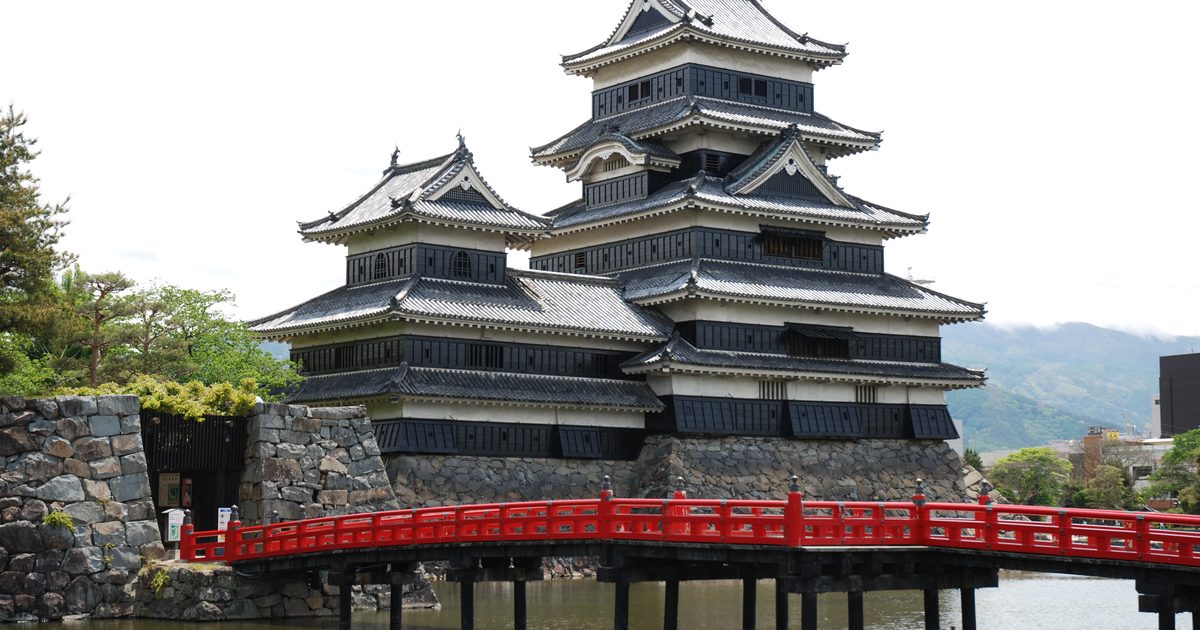
Matsumoto Castle's black keep looks complete from the moat, but the best of it is inside. It's the oldest surviving five-tiered, six-floor keep among Japan's 12 original keeps, and you climb through it on timber stairs and wooden floors, in socks. This guide takes you through it in the order you'll meet it: the five National Treasure structures, the stone steps of the way in, each of the main keep's six floors, the two graceful peacetime turrets and the practical rules that shape a visit. Plan on 45 to 60 minutes inside on average, about 140 steps to the top and no lift. If you know what's on each floor before you start, you'll know where to linger and where to keep moving.
Five National Treasures, one route
The castle isn't one building but five, and all five are National Treasures. The Daitenshu is the main keep. The Inui-kotenshu is the smaller keep to the north-west. The Watari-yagura is the connecting turret that joins them. The Tatsumi-tsukeyagura is an annex turret on the south-east side, and the Tsukimi-yagura is the moon-viewing turret. They were designated a National Treasure on 20 April 1936 and re-designated in 1952 under the Cultural Properties Protection Law.
They weren't all built at once. Matsumoto City's official view is that the main keep, the Inui keep and the Watari turret went up in 1593–94 under Ishikawa Kazumasa and his son Yasunaga, when war was still a real prospect. The Tatsumi and Tsukimi turrets were added about 40 years later, in peacetime. You can feel the change as you walk through: thick walls and gun slots first, then open sides and lacquered railings.
Because the buildings are joined, the visit runs as one continuous route. You go in through the Watari turret and climb the six floors of the main keep; the two later turrets are joined to it on the same visit. The Inui small keep itself is largely off limits for now. Its first and second floors are closed after a seismic assessment, and its third and fourth floors are normally closed anyway.
Getting in: Kuromon, the Watari steps and your shoes
There's only one way into the paid area: the Kuromon Gate on the south side. The red Uzumibashi bridge you'll see in photos is closed, so don't head for it. Inside, you walk through the Honmaru Garden to the keep entrance. With the castle's timed e-ticket, you go in through the e-ticket entrance at the Kuromon ticket office and show the QR code again at the keep entrance. Take a screenshot first, as phone signal can be poor in crowds.
On busy days the keep has its own queue. The official homepage shows a live wait time, and during Golden Week and Obon entry to the keep is limited for safety, with the queue running along a set route through the garden. A timed ticket saves you buying at the window on the day. It doesn't let you jump the keep queue.
You enter the keep by the stone steps of the Watari turret. At the entrance you're handed a bag for your shoes, because the whole interior is shoes-off, and you carry them with you all the way round. Pack light. Coin lockers in the Honmaru Garden take small bags, and the shop will look after larger ones as long as there's nothing valuable or breakable inside.
First floor: stone drops and the warriors' corridor
The first floor sets the tone. Black-lacquered weatherboards clad the outside, with white plaster above, and the walls here and on the floor above are about 29 cm thick. Watch for the stone-drop hatches, openings through which defenders could attack anyone at the foot of the walls. The castle has 11 of them in all, plus 115 gun and arrow slots.
Around a raised central core runs the musha-bashiri, the warriors' corridor, which let soldiers move quickly to wherever the walls were threatened. This floor also displays timbers that were replaced during the Shōwa repair, so you can see old structural wood at eye level rather than overhead.
The floors are smooth, worn wood. In socks, walk rather than hurry, and keep an eye out for the foot of the first staircase.
Second floor: the matchlock gun museum
The second floor holds the Matsumoto Castle Matchlock Gun Museum. Its core is a donation from Akabane Michishige and Kayoko: 141 matchlocks plus armour, part of which is on display.
It's the best place in the keep to understand why the castle looks the way it does. The inner moat is about 60 m wide, which was the accurate range of a matchlock, and the slots in the walls around you were made for exactly these weapons. Visit in spring or autumn and you may also catch a matchlock firing display.
This floor tends to slow everyone down. If the line behind you is long, pick a few pieces to look at properly, then move on. There's plenty of climbing still ahead.
Third floor: the hidden floor
From outside, you'd never guess the third floor exists. It's tucked under the second roof with no windows at all, which is why it's known as the hidden floor. The keep shows five tiers of roof but holds six floors, and this is the one the roofs conceal.
In wartime it served for storage and as a refuge. Today it's dim, low-ceilinged and quiet, a natural pause between steep flights. Give your eyes a moment to adjust before you take the next stairs, especially if you've just come from the brighter floor below.
It's worth noticing what isn't here. There's nothing to read on the walls and no view to look at, and that's the point. A floor no attacker could see from outside was a safe place to keep supplies and people, and standing in it helps you picture the keep as a working fortress rather than a museum.
Fourth floor: the lord's seat room and the 61° stairs
The fourth floor holds the gozasho, the lord's seat room. It's a space meant for the castle's master rather than his soldiers, and it feels more composed than the floors beneath it.
It's also where the climb gets serious. The staircase here is the steepest in the keep, at about 61°, and it rises through a storey nearly 4 m high. Treads are narrow and risers high, so climb facing the steps with a hand on the rail. Photography isn't allowed near the stairs, for safety, so put your phone away before you start.
Remember you'll come down this way too. Take the descent slowly and don't let the people behind you set your pace.
Fifth floor: the strategy room and the rope-mark pillar
The fifth floor was the strategy room, where senior retainers would gather in time of war. Unlike the hidden floor, it has windows on every side, so commanders could watch every approach at once.
Look for a pillar on the north side. It's said to bear marks from the ropes used during the Meiji repair of 1903–1913, when the leaning keep was pulled straight. Treat it as a story rather than proof, but it's a lovely detail to hunt for, and it links straight back to the citizens who saved the building.
With windows all round, this is where the view starts to open over the moats and the town. Save your long look for the floor above, where the view reaches over the city to the mountains and the climb is finally behind you.
Sixth floor: the moon shrine, the hanegi beams and the Alps
The top floor is the reward for about 140 steps. Up here is a shrine to Nijūrokuya, the deity of the moon on the 26th night, enshrined by the Toda clan from 1617.
Look up and you'll see the hanegi, roof beams radiating from the centre to carry the top roof. It's one of the clearest views you'll get of how the keep is put together. The whole building weighs about 1,000 t and stands on 16 hemlock log supports.
Then go to the windows. Matsumoto is a flatland castle at 590 m above sea level, and from here the view runs over the city to the Northern Alps. In winter, snow on the mountains sits behind the town.
The top floor fills up quickly. Take your look, then start down so the people climbing behind you get theirs.
The peacetime turrets: Tatsumi and Tsukimi
After the main keep you reach the two turrets added in peacetime, about 40 years after the keep: the Tatsumi-tsukeyagura, the south-east annex turret, and the Tsukimi-yagura, the moon-viewing turret.
The Tsukimi-yagura has the better story. Lord Matsudaira Naomasa began building it in 1633 for a planned visit by the shogun Tokugawa Iemitsu in 1634. The visit never came. What remains is a room open on three sides, its sliding board doors removed so you could watch the moon, with a vermilion-lacquered railing round the edge and a curved boat-bottom ceiling above.
It's the opposite of the keep's war floors: no gun slots, just air and light. Stand at the railing for a minute and look back at the black keep you've just climbed.
One note for autumn 2026. From 24 August to 31 October the castle is carrying out lacquer maintenance. The keep interior is open as usual, but part of the Tsukimi-yagura can't be entered while the lacquer dries.
Rules inside, time needed and who should think twice
There's no elevator and no accessibility adaptation inside the keep. You'll climb about 140 steps to the sixth floor on narrow, steep stairs with high risers. Wheelchairs can't enter the keep, though free wheelchairs are lent at the Kuromon ticket office and two car parks for getting round the grounds, with no reservations.
There are no toilets inside the keep, so go before you queue: there's an accessible toilet in the Honmaru Garden and two in the park. Strollers stay outside, at the management office or the keep entrance. Pets aren't allowed in the garden or the keep, even in carriers; certified service dogs are accepted with advance contact. No photos near the stairs, no eating in the Honmaru Garden, no smoking and no drones.
The castle's own guide puts the average time inside at 45 to 60 minutes. On a quiet day you can be through in 30 to 40 minutes. When it's crowded, expect about an hour, plus however long the queue to enter the keep takes.
Who should think twice? If stairs are hard for you, the 61° flight and the climb back down are a real challenge, and there's no other way up. Families with very young children should know that carrying a small child up and down these stairs, with your shoes in a bag, is tiring and needs care. Children aged 5 and under enter free and need no ticket at all, so one adult can wait with them in the garden while the others climb.
How two citizens saved the keep
The keep you climb nearly didn't survive. In 1872 it was put up for auction. Ichikawa Ryōzō held five exhibitions inside the keep from 1873 and used them to buy it back.
By the turn of the century the keep was leaning. In 1901 Kobayashi Unari founded a preservation society that raised money for repairs, and the Meiji repair of 1903–1913 straightened it. That's the work the fifth-floor pillar is said to remember.
Not everything made it. The Honmaru Palace burned in 1727 and was never rebuilt, and the Kuromon gate you came in by is a 1960 reconstruction. The five National Treasure structures are what remains of the original castle, and thanks to those two men, you can still walk all six floors. As you leave, it's worth remembering that the building survived because people in the town decided it was worth keeping.
Frequently asked
How long does it take to see inside Matsumoto Castle?
About 45 to 60 minutes inside the keep on average. Allow 30 to 40 minutes on a quiet day and about an hour when it's crowded, plus any wait to enter the keep.
How many steps are there to the top of the keep?
About 140 steps to the sixth floor. The stairs are narrow with high risers, and the steepest flight, on the fourth floor, is about 61°.
Is there an elevator in Matsumoto Castle?
No. The keep has no elevator and no accessibility adaptations, and wheelchairs can't enter. Free wheelchairs are lent at the Kuromon ticket office and two car parks for the grounds, with no reservations.
Do I have to take my shoes off?
Yes. The whole keep is shoes-off. You're handed a bag at the entrance and carry your shoes with you through the building, so wear clean socks and pack light.
Are there toilets inside the keep?
No. There are no toilets in the keep. Use the accessible toilet in the Honmaru Garden or one of the two in the park before you join the queue.
Can I take photos inside the keep?
Yes, except near the stairs, where photography isn't allowed for safety. Put your phone away while you're climbing or coming down.
Can I bring a stroller or young children?
Strollers can't go in; leave them at the management office or the keep entrance. Children aged 5 and under enter free and need no ticket, but you'll be carrying very young children up and down steep stairs.
Can I go inside the Inui small keep?
Not fully at the moment. Its first and second floors are closed after a seismic assessment, and its third and fourth floors are normally closed. The rest of the route through the connected structures is unaffected.
Is the Tsukimi turret open in autumn 2026?
Partly. From 24 August to 31 October 2026, lacquer maintenance means part of the Tsukimi-yagura can't be entered while the lacquer dries. The keep interior stays open as usual.